
Wednesday, January 16, 2013

...Wrapped in an Enigma, Smothered in Secret Sauce
So dad, seeing that list of WAR leaders for the Yankees is pretty cool. It's cool when things you think you "know" about baseball tumble out of the stats.
I had two things I wanted to add; the first is about Joe D and the Mick; and the second is about how I finally was able to wrap my head fully around your "'stats' are outcomes" notion.
Starting broadly, Bill James, the Sabermetric Moses, when discussing his background assumptions for his Win Shares system of statistical analysis, discussed Joe DiMaggio and Rusty Staub. Nobody would mistake Rusty for Joe, but since their raw Win Share value were nearly identical, James decided on how to finagle the numbers to help them correspond with people's observations. He arrived at a system that mixed a player's raw values, their the three best seasons, and their best five year stretch with minor adjustments for league averages and park effects.
One thing he says about DiMaggio is that he was a great player during those three years he spent in the military, he just couldn't play. I think everyone would agree. I also think that if you were to claim that during those three years he could have been good for an average of 6 WAR a year, nobody would say that's totally out of the question. Some may say that it's too low. But, if you add 18 wins to his score, it'll be closer to 100, and his raw WAR value would be closer to Mickey's.
Another thing that Bill James claimed is that league averages show that the game in the late '30s and and early '40s was a much higher scoring affair than the late '50s and early '60s, and that this leads to the result that runs were at a premium during Mantle's era, and his run production was more significant to the team and the American League than DiMaggio's. You can take that leap if you buy the stats-based argument, but you have to convince yourself that 107 RBIs were more significant than 147.
Maybe the raw WAR values bear out certain feelings Bill James has about Mantle and DiMaggio (besides the missing 18-20 wins for Joe D lost during his military service).
When you first brought up the outcomes discussion with me on the phone, I felt it, but not fully immersed in how different a point of view it demands. I think I may have it, though. Correct me, please, if you feel I'm way off.
Let's say we create a player, last name Schmoe, first name Joseph. Let's say Joseph starts the season on a tear, killing the ball. In the first five games almost nobody can get him out, and he goes 16 for 21, for a .762 average. ESPN does opposing segments about Schmoe; one about it's still early in the season, and we should all just wait, and another segment about Where did this guy come from, and can he sustain it, and when is "too early" to start thinking about .400...
The .400 talk is obviously stupid, since our Joseph ball-player falls into a slump, and over the next 10 games goes hitless, say an 0 for 42 fortnight. Now, Mr. Schmoe, through less than ten percent of the season is hitting 16 for 63, which is good for a .254 clip.
These are statements of outcomes, not necessarily bankable expectations. You know that if you roll a die you've got a fifty percent chance to get an even number. On game 16 of Schmoe's season we're discussing, his chances of going 0 for 4 or going 5 for 5 have far more to do with his mental state that day, whether the pitcher he's facing is on his game, whether the game is outside and cold, whether or not he's loosened up by a dirty joke...many possible things that have nothing to do with his .254 average.
In that Game 16 he's not more likely to get 1 hit in 4 at-bats (a .250 average) because of his average. He'll go 1 for 4 because the pitcher got him to dribble the ball over to the shortstop on a second inning sinker; then he hung a curve ball that Schmoe roped to center; later Schmoe smashed a ball deep that was caught on the warning track; and then he struck out looking at pitch number 17 from a reliever late in the game. Or any other possible set of circumstances that lead to any other set of outcomes.
The point is that his success to end a slump almost rests more with the pitcher he's facing that day than with himself, unless his mechanics are a total mess.
Now what if we switch the timing on Joseph's hot streak and slump. Say in late July, maybe game 116, Schmoe starts a five game tear, killing the ball, going 16 for 21 and raising his average a few points. He's proclaimed player of the week. Then, say, he goes into the ten game slump, and we're getting ready for game 132 in August. Can we say that Joseph's chances in game 132 on getting a hit are based on his batting average?
Just like in game 16, it seems like his chances of getting a hit might have more to do with the pitcher he'll be facing than whatever stats he's built up to that time. Right? Isn't that the kernel of the idea that using outcomes as a method of extrapolating future performances is inherently flawed?
Isn't baseball awesome?
Okay, one more thing: Who are the two best Yankee pitchers? There are many candidates, but let's say for the sake of what I'm trying to illustrate, we go with Whitey and Mo. Plenty of Yankee fans younger than myself would have no problem putting Rivera on that list, but they may not even know about Whitey.
I, too, am a huge fan of Big Mo, and have seen him save games in person more than once. And I, too, feel kinda funny placing a guy who has pitched just over 1200 innings in the same breath with a guy who pitched almost 3200. The word that's used is "leveraged" innings, like a closer has more to do with the final outcome of a game than a starter. What stat, besides Saves, does Mariano have the lead over Whitey Ford? The lead is not trivial either; it's more than a factor: games.
Mo appeared in 1051 games to Whitey's 498 games. This leads to modern day relievers being seen by the public as closer to position players maybe. What does this mean? Can we make any conclusions?
Two things to end with: 1) A starting pitcher can give up seven runs, leave with his team behind, and the team can still win the game--did that starter have more to do with the outcome of that game than the last pitcher up there closing the door on the other team? And 2) Between 1961 and 1965, Whitey Ford faced more batters than Mariano Rivera has faced in his 18 year career, and we're somehow supposed to rank Mo on the same level as Whitey?
I love baseball...
I had two things I wanted to add; the first is about Joe D and the Mick; and the second is about how I finally was able to wrap my head fully around your "'stats' are outcomes" notion.
Starting broadly, Bill James, the Sabermetric Moses, when discussing his background assumptions for his Win Shares system of statistical analysis, discussed Joe DiMaggio and Rusty Staub. Nobody would mistake Rusty for Joe, but since their raw Win Share value were nearly identical, James decided on how to finagle the numbers to help them correspond with people's observations. He arrived at a system that mixed a player's raw values, their the three best seasons, and their best five year stretch with minor adjustments for league averages and park effects.
One thing he says about DiMaggio is that he was a great player during those three years he spent in the military, he just couldn't play. I think everyone would agree. I also think that if you were to claim that during those three years he could have been good for an average of 6 WAR a year, nobody would say that's totally out of the question. Some may say that it's too low. But, if you add 18 wins to his score, it'll be closer to 100, and his raw WAR value would be closer to Mickey's.
Another thing that Bill James claimed is that league averages show that the game in the late '30s and and early '40s was a much higher scoring affair than the late '50s and early '60s, and that this leads to the result that runs were at a premium during Mantle's era, and his run production was more significant to the team and the American League than DiMaggio's. You can take that leap if you buy the stats-based argument, but you have to convince yourself that 107 RBIs were more significant than 147.
Maybe the raw WAR values bear out certain feelings Bill James has about Mantle and DiMaggio (besides the missing 18-20 wins for Joe D lost during his military service).
When you first brought up the outcomes discussion with me on the phone, I felt it, but not fully immersed in how different a point of view it demands. I think I may have it, though. Correct me, please, if you feel I'm way off.
Let's say we create a player, last name Schmoe, first name Joseph. Let's say Joseph starts the season on a tear, killing the ball. In the first five games almost nobody can get him out, and he goes 16 for 21, for a .762 average. ESPN does opposing segments about Schmoe; one about it's still early in the season, and we should all just wait, and another segment about Where did this guy come from, and can he sustain it, and when is "too early" to start thinking about .400...
The .400 talk is obviously stupid, since our Joseph ball-player falls into a slump, and over the next 10 games goes hitless, say an 0 for 42 fortnight. Now, Mr. Schmoe, through less than ten percent of the season is hitting 16 for 63, which is good for a .254 clip.
These are statements of outcomes, not necessarily bankable expectations. You know that if you roll a die you've got a fifty percent chance to get an even number. On game 16 of Schmoe's season we're discussing, his chances of going 0 for 4 or going 5 for 5 have far more to do with his mental state that day, whether the pitcher he's facing is on his game, whether the game is outside and cold, whether or not he's loosened up by a dirty joke...many possible things that have nothing to do with his .254 average.
In that Game 16 he's not more likely to get 1 hit in 4 at-bats (a .250 average) because of his average. He'll go 1 for 4 because the pitcher got him to dribble the ball over to the shortstop on a second inning sinker; then he hung a curve ball that Schmoe roped to center; later Schmoe smashed a ball deep that was caught on the warning track; and then he struck out looking at pitch number 17 from a reliever late in the game. Or any other possible set of circumstances that lead to any other set of outcomes.
The point is that his success to end a slump almost rests more with the pitcher he's facing that day than with himself, unless his mechanics are a total mess.
Now what if we switch the timing on Joseph's hot streak and slump. Say in late July, maybe game 116, Schmoe starts a five game tear, killing the ball, going 16 for 21 and raising his average a few points. He's proclaimed player of the week. Then, say, he goes into the ten game slump, and we're getting ready for game 132 in August. Can we say that Joseph's chances in game 132 on getting a hit are based on his batting average?
Just like in game 16, it seems like his chances of getting a hit might have more to do with the pitcher he'll be facing than whatever stats he's built up to that time. Right? Isn't that the kernel of the idea that using outcomes as a method of extrapolating future performances is inherently flawed?
Isn't baseball awesome?
Okay, one more thing: Who are the two best Yankee pitchers? There are many candidates, but let's say for the sake of what I'm trying to illustrate, we go with Whitey and Mo. Plenty of Yankee fans younger than myself would have no problem putting Rivera on that list, but they may not even know about Whitey.
I, too, am a huge fan of Big Mo, and have seen him save games in person more than once. And I, too, feel kinda funny placing a guy who has pitched just over 1200 innings in the same breath with a guy who pitched almost 3200. The word that's used is "leveraged" innings, like a closer has more to do with the final outcome of a game than a starter. What stat, besides Saves, does Mariano have the lead over Whitey Ford? The lead is not trivial either; it's more than a factor: games.
Mo appeared in 1051 games to Whitey's 498 games. This leads to modern day relievers being seen by the public as closer to position players maybe. What does this mean? Can we make any conclusions?
Two things to end with: 1) A starting pitcher can give up seven runs, leave with his team behind, and the team can still win the game--did that starter have more to do with the outcome of that game than the last pitcher up there closing the door on the other team? And 2) Between 1961 and 1965, Whitey Ford faced more batters than Mariano Rivera has faced in his 18 year career, and we're somehow supposed to rank Mo on the same level as Whitey?
I love baseball...
Monday, January 14, 2013
A baseball riddle, not to be solved

Baseball is a beautiful game for a number of reasons, not least of which is the timeless debate over how games are won. We sit and witness the pitches and the hits and the plays, and yet when the whole thing is done, why did the one team beat the other? I have always contended that the starting pitcher rules between 90% and 95% of the outcome. If your starter is around league average or slightly above, and he has reasonable control, strength, and mechanics that day, your chances are pretty good. So says I.
I have seen opinions vary away from that standard; I've even seen the ratio of 50-50 pitching vs. hitting, at which I scoff! Scoff, I tell ya. And lately baseball has enjoyed an influx of geeky guys who like to take statistical samples and interpolate outcomes. This is not a bad thing, but when I have taken the trouble to explore the formulae used in some of these calculations, I'm left frowning in doubt. One of the most popular new statistical measures is WAR, or wins above replacement player. A replacement player is someone you bring in to replace an injured major-leaguer. He might have some major league experience, but isn't what you'd consider optimal. I saw recently that the standard had been calculated that if you had 25 replacement players, you'd win 43-48 games in a season. So replacement players suck, to say the least.
WAR purports to measure how many games did your team win as a result of YOU being on the team. These are games won all by your lonesome, simply as the result of your own awesomeness. It measures offensive and defensive contributions, again, purportedly. For reference, Mike Trout of the Los Angeles Angels of Anaheim had the highest WAR in the American League, 10.7. Robbie Cano of the Yankees was second, with 8.2. A 1-WAR player is estimated to be worth $4 million in salary, so, that gives you some reference.
Pitchers have WAR, too, but I struggle with that part of it. If a guy wins 15 games, or let's say his team wins 20 of the 32 games he started, how is that not, like, 20 WAR? I assume it gets down to methods of calculation. It seems like (I don't know, not being an expert in these things) they give more credit to guys who go out there every day. Okay, if your guy goes out there every day, and has, say, influence over one-ninth of the game (nine guys in the lineup, right, both at bat and in the field?), let's say over five days, he has a cumulative influence over five-ninths of the outcomes. Meanwhile, your starting pitcher had nine-tenths influence over one game. 90% is higher than 56%, isn't it?
There's another problem with a lot of these new calculations: they seem to place weight on the cumulative aspect of a lot of baseball stats. How does that help when you have a new outcome every day? The slate is wiped clean before every game, wouldn't you say?
So, now I'm going to appeal to Pat's sense of Yankee history. Baseball-reference.com is an amazingly comprehensive site. One of my extremely geeky activities is following all-time Yankee stats, and lo and behold, you can look up all-time Yankee WAR stats on Baseball-reference. Here are a couple of tables:
| Rank | Player | WAR | PA |
| 1 | Babe Ruth | 138.2 | 9,198 |
| 2 | Lou Gehrig | 108.5 | 9,663 |
| 3 | Mickey Mantle | 105.5 | 9,907 |
| 4 | Joe DiMaggio | 75.1 | 7,673 |
| 5 | Derek Jeter | 69.3 | 11,895 |
| 6 | Yogi Berra | 56.2 | 8,350 |
| 7 | Bill Dickey | 52.4 | 7,064 |
| 8 | Willie Randolph | 51.7 | 7,464 |
| 9 | Alex Rodriguez | 49.8 | 5,476 |
| 10 | Bernie Williams | 45.9 | 9,053 |
| 11 | Tony Lazzeri | 44.7 | 7,068 |
| 12 | Thurman Munson | 43.3 | 5,905 |
| 13 | Roy White | 43.0 | 7,735 |
| 14 | Graig Nettles | 41.0 | 6,248 |
| 15 | Earle Combs | 40.0 | 6,513 |
(PA is plate appearances)
This is a pretty cool list in that it reinforces the rough ranking that we as Yankee geeks place on our all-time guys.There are maybe a couple of surprises in there, but the overall ranking is hard to argue with. One surprise - Mantle was so much more valuable than DiMaggio, at least by this measure. Okay, let's look at Yankee pitchers:
| Rank | Player | WAR | IP |
| 1 | Mariano Rivera | 52.7 | 1,219.67 |
| 2 | Whitey Ford | 50.6 | 3,170.33 |
| 3 | Andy Pettitte | 45.8 | 2,611.00 |
| 4 | Ron Guidry | 45.4 | 2,392.00 |
| 5 | Red Ruffing | 41.7 | 3,168.67 |
| 6 | Lefty Gomez | 39.5 | 2,497.33 |
| 7 | Bob Shawkey | 39.0 | 2,490.00 |
| 8 | Mel Stottlemyre | 37.5 | 2,661.33 |
| 9 | Mike Mussina | 33.1 | 1,553.00 |
| 10 | Waite Hoyt | 32.0 | 2,273.33 |
| 11 | Herb Pennock | 29.9 | 2,202.67 |
| 12 | Ray Caldwell | 27.1 | 1,718.33 |
| 13 | Jack Chesbro | 26.6 | 1,952.00 |
| 14 | Russ Ford | 24.3 | 1,112.67 |
| 15 | Dave Righetti | 21.8 | 1,136.67 |
Here I get a little skeptical. Or do I? Only a few of the pitchers would make it onto the WAR chart for position players. I don't know if I agree. And how can Mariano Rivera (who has no bigger fan than me, by the way) be more valuable that Whitey Ford? Ford had greater influence over the games he pitched, right? Aren't 7 successful innings more important than one? Okay, Mariano did pitch in quite a few games, and faced a lot of high-leverage situations. Still don't know what to make of all this. There is a yin and yang of truth, and I don't know if it can be puzzled out.
I started out hoping to pose a question and a thesis about how games are won, but it's another reason the game is a beautiful conundrum: it's all right there before our eyes, day in and day out, but there is no knowing or explaining it.
Saturday, January 5, 2013
Super Hero, Part 2
Dan, you got me thinking a bit about comic book superheroes. I just wanted to add a little something.
When I moved back to SLO in 2000, I took a single box of comics with me. It had my Frank Miller stuff, some of my more beloved Joe Quesada material, my original copies of Kingdom Come, and that was pretty much it. Except for:

The Spectre is one of the Old School DC characters, and that capitalization is deliberate. The character himself has had a few incarnations. Jim Corrigan, an Irish cop in New York, is gunned down by the gangsters he's investigating. Upon dying he's fused with the Spirit of Vengeance, and sent back to earth to find those gangsters and mete out justice.
Somehow they weren't able to give the character any teeth, falling out of repute after WWII. He was brought back in the '80s as the top character in DC's "magic realm" characters: Dr. Fate, Horus, the Demon, Eclipse...
The series of the Spectre that I was a fan of, the series from above, is from the '90s, when they finally found a way to make the character interesting. John Ostrander was the main writer, and he was a biblical scholar and the stories are always about morality (with very little religiosity involved).
The next round they took Jim Corrigan away from the Spectre, and fused Hal Jordan, the erstwhile (at the time) Green Lantern, with the Spirit of Vengeance.
That wasn't so great.
In the series I read and liked, the Spectre's dilemmas were between the super-harsh Spirit of Vengeance and the human aspect of Jim Corrigan as together they dealt with the decisions and actions of the random baddies they'd encounter during the course of the issues.
So what?
The younger Marvel Comics universe has their stable of classic superheroes. They were flawed and filled with angst and generally more interesting. The X-Men is about prejudice for cripes sake.
But for the archetype of comic book superhero? There's only two: Superman and Batman. I liked the Flash and Aquaman and Hawkman and Green Lantern, for sure, but really, there're only two 800 pound gorillas.
Superman can shoot lasers from his eyes, bullets can't hurt him, he has super running speed, he can fly, and can fly through space unharmed. Batman is only a man, which is his draw. The DC universe doesn't mess around with these two guys. They're equals.
The only character they ever really created to give Superman more than he could handle, besides Doomsday, was the silly spoofy character Lobo. Supes and Lobo fought to a draw, and Superman had to trick Lobo into thinking he was dead. I liked the Lobo character, but mainly for this tongue in cheek assholery and the spoof factor. (Lobo spoofed a mix of Wolverine and ultra-violence.)
Again, so what?
Superman and Batman, and issue #22 of The Spectre above. I trucked that issue down to SLO with me. I took it to New York, to Texas, and pulled it out of my box long enough to snap some pictures of it today.
In the issue, Superman is asked to locate and destroy the mysterious Spear of Destiny, an all powerful tool that Hitler had been searching for. The Spectre, who spends most issues going around and finding people in moral quandaries and then (usually) meting out crazy justice, comes to Superman and tells him not to pursue the Spear.
It will corrupt you, he tells Supes. Eff that, is Superman's response paraphrased. He obtains the Spear, does in the Spectre after becoming tainted, and then sets about destroying the entire DC universe, killing just about every famous or not-so famous character, until he realizes how royally he fucked up.
As I was reading it for the first time, I realized there was one character who's fate hadn't been shown during Superman's demolition, and he was an important character. It turned out that after Superman had pretty much destroyed the world, the last guy who could possibly stop him was...
You better say Batman. He has Kryptonite bullets, and is ready to gun down Bog Blue. As the issue winds down, we see this:
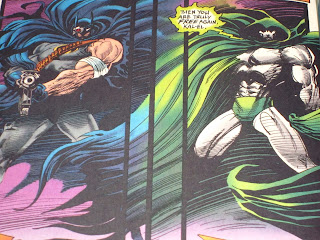
The last man standing against world-crushing Superman is Batman, but really it's the Spectre having conjured a drastic vision of Superman destroying the world because he got tainted. It's a goddamned lesson. The Spectre was just messing with Superman.
Superman gets it, and lets the Spectre dispose of the Spear. But the real lesson is for the rest of us: Superman and Batman are equals in the DC universe, and everybody toes the line. The Spectre, back in 1994, could be considered more powerful, but less of a social symbol...
It remains my all-time favorite single issue run-of-the-mill mid-'90s DC Comics comic book. It's better than Aquaman getting his hand chewed off by angry piranhas, which could be #2 on that specialized list. That, or Hal Jordan going into the main battery on Ohm, destroying the Green Lantern Corps and basically kicking off the start of the Zero Hour major crossover. Aquaman and Hal are a distant second and third. [[Sorry for the NERD talk...]]
When I moved back to SLO in 2000, I took a single box of comics with me. It had my Frank Miller stuff, some of my more beloved Joe Quesada material, my original copies of Kingdom Come, and that was pretty much it. Except for:

Somehow they weren't able to give the character any teeth, falling out of repute after WWII. He was brought back in the '80s as the top character in DC's "magic realm" characters: Dr. Fate, Horus, the Demon, Eclipse...
The series of the Spectre that I was a fan of, the series from above, is from the '90s, when they finally found a way to make the character interesting. John Ostrander was the main writer, and he was a biblical scholar and the stories are always about morality (with very little religiosity involved).
The next round they took Jim Corrigan away from the Spectre, and fused Hal Jordan, the erstwhile (at the time) Green Lantern, with the Spirit of Vengeance.
That wasn't so great.
In the series I read and liked, the Spectre's dilemmas were between the super-harsh Spirit of Vengeance and the human aspect of Jim Corrigan as together they dealt with the decisions and actions of the random baddies they'd encounter during the course of the issues.
So what?
The younger Marvel Comics universe has their stable of classic superheroes. They were flawed and filled with angst and generally more interesting. The X-Men is about prejudice for cripes sake.
But for the archetype of comic book superhero? There's only two: Superman and Batman. I liked the Flash and Aquaman and Hawkman and Green Lantern, for sure, but really, there're only two 800 pound gorillas.
Superman can shoot lasers from his eyes, bullets can't hurt him, he has super running speed, he can fly, and can fly through space unharmed. Batman is only a man, which is his draw. The DC universe doesn't mess around with these two guys. They're equals.
The only character they ever really created to give Superman more than he could handle, besides Doomsday, was the silly spoofy character Lobo. Supes and Lobo fought to a draw, and Superman had to trick Lobo into thinking he was dead. I liked the Lobo character, but mainly for this tongue in cheek assholery and the spoof factor. (Lobo spoofed a mix of Wolverine and ultra-violence.)
Again, so what?
Superman and Batman, and issue #22 of The Spectre above. I trucked that issue down to SLO with me. I took it to New York, to Texas, and pulled it out of my box long enough to snap some pictures of it today.
In the issue, Superman is asked to locate and destroy the mysterious Spear of Destiny, an all powerful tool that Hitler had been searching for. The Spectre, who spends most issues going around and finding people in moral quandaries and then (usually) meting out crazy justice, comes to Superman and tells him not to pursue the Spear.
It will corrupt you, he tells Supes. Eff that, is Superman's response paraphrased. He obtains the Spear, does in the Spectre after becoming tainted, and then sets about destroying the entire DC universe, killing just about every famous or not-so famous character, until he realizes how royally he fucked up.
As I was reading it for the first time, I realized there was one character who's fate hadn't been shown during Superman's demolition, and he was an important character. It turned out that after Superman had pretty much destroyed the world, the last guy who could possibly stop him was...
You better say Batman. He has Kryptonite bullets, and is ready to gun down Bog Blue. As the issue winds down, we see this:

The last man standing against world-crushing Superman is Batman, but really it's the Spectre having conjured a drastic vision of Superman destroying the world because he got tainted. It's a goddamned lesson. The Spectre was just messing with Superman.
Superman gets it, and lets the Spectre dispose of the Spear. But the real lesson is for the rest of us: Superman and Batman are equals in the DC universe, and everybody toes the line. The Spectre, back in 1994, could be considered more powerful, but less of a social symbol...
It remains my all-time favorite single issue run-of-the-mill mid-'90s DC Comics comic book. It's better than Aquaman getting his hand chewed off by angry piranhas, which could be #2 on that specialized list. That, or Hal Jordan going into the main battery on Ohm, destroying the Green Lantern Corps and basically kicking off the start of the Zero Hour major crossover. Aquaman and Hal are a distant second and third. [[Sorry for the NERD talk...]]
Friday, January 4, 2013
New Movies
So, here is the list that the other film reviewer and I are going to do see... let me know if there are reviews you'd like to see:
The Hobbit
Djoango
Texas Chainsaw 3-D
Mama
A Good Day To Die Hard (I mean... how can I not!!!!)
The plan is that we are seeing the first on the list later on today... like in about tweleve hours... but I still need to sleep and worry about dinner. Hopefully this finds everyone in good spirits and will leave you all with a great picture. Monies to anyone who knows this picture...

The Hobbit
Djoango
Texas Chainsaw 3-D
Mama
A Good Day To Die Hard (I mean... how can I not!!!!)
The plan is that we are seeing the first on the list later on today... like in about tweleve hours... but I still need to sleep and worry about dinner. Hopefully this finds everyone in good spirits and will leave you all with a great picture. Monies to anyone who knows this picture...

Just kidding.
Unusual for me ...

Maybe it was because I was the new guy, maybe it was because the second guy I interviewed with is definitely six or seven years older than I am, but I always imagined Barry and I to be pretty close to the same age, without really focusing on it too much. Well, I found out Barry's six years younger than I am, and while that puts him firmly in his mid-50s, the realization arrested me a little bit. I don't usually think about my age, except to consider it "just a number," but for a while yesterday I had the strange, not-very-pleasant novelty of feeling like the old guy.
You hear a lot about older guys - the physical infirmities, the limits on stamina, etc., but I can definitely say that there are new compensations with each passing year. There are things that I understand that wouldn't have been so obvious even ten years ago - just different aspects of life and fortune and philosophy and perception. And on this job, I feel like "the monarch of the sea," to quote Sallah from Raiders of the Lost Ark - the boss, the guy with the answers. So ... it was a strange moment of vulnerability, a bit of a kryptonite sensation. It passed quickly enough.
Thursday, January 3, 2013
Super Hero
I was recently (in the past year) at a training seminar and was asked at the start who my favorite Super Hero was. In a room of my peers answers started flying. As the leader of the seminar asked each of us the answers were varied: Wolverine - He can take a beating... like most of us here. Superman - He has super strength and can fly. Green Lantern - He can conjure up anything he wants as a weapon.
When they got to a peer, a few seats ahead of me, the woman stated her hero was her mother. Seeing where this was going, I sorta tuned out. Nothing against mothers, but I thought the question was 'Who is your favorite SUPER HERO?' I have no doubt that mothers do a whole bunch for their offspring, but that was not the prompt we were given.
When he came to me (finally, I might add) I responded with Batman. Now, there are some people who can state he is NOT a super hero. Some of my other peers state he is more of a rich man with issues. True. I will not argue that. But, seeing as how he is an actual fictitious character I figured it would work. I stated that he was my favorite because he is just a man. A man, who like it or not, can be killed with a bullet and with that in mind, he still finds a way to beat the stuffing out of the enemy.
Fast forward to today... I am taking some time off after our peak season to rest and relax... too many trips and packages. As I sit at home (too cold outside to do much while not safely tucked in the warmth of the fire place here at Basswood) I found some movies on the instant streaming database of Netflix. Of course, as the title of this post, they are Super Hero based.
Justice League: Doom
The first offering was, as I thought, supposed to be a Batman movie. That, my friends, is what I get for not reading the actual title.


When they got to a peer, a few seats ahead of me, the woman stated her hero was her mother. Seeing where this was going, I sorta tuned out. Nothing against mothers, but I thought the question was 'Who is your favorite SUPER HERO?' I have no doubt that mothers do a whole bunch for their offspring, but that was not the prompt we were given.
When he came to me (finally, I might add) I responded with Batman. Now, there are some people who can state he is NOT a super hero. Some of my other peers state he is more of a rich man with issues. True. I will not argue that. But, seeing as how he is an actual fictitious character I figured it would work. I stated that he was my favorite because he is just a man. A man, who like it or not, can be killed with a bullet and with that in mind, he still finds a way to beat the stuffing out of the enemy.
Fast forward to today... I am taking some time off after our peak season to rest and relax... too many trips and packages. As I sit at home (too cold outside to do much while not safely tucked in the warmth of the fire place here at Basswood) I found some movies on the instant streaming database of Netflix. Of course, as the title of this post, they are Super Hero based.
Justice League: Doom
The first offering was, as I thought, supposed to be a Batman movie. That, my friends, is what I get for not reading the actual title.

I do, however, believe that my original thought stands. It does seem like a Batman film.
For those who are not familiar with the story line this film is about the JLA (Justice League of America) vs. the Legion of Doom. Fan favorites abound... Batman, Superman, the Flash, Wonder Woman, the Martian Man-hunter the Green Lantern, and contrary to the comic story line this is based on, Cyborg. Missing, however, was Aquaman and Plastic Man.
Among the Legion... there was Bane, Metallo, Cheetah, Mirror Man, Star Sapphire and Vandal Savage (the 50,000 year old Man). It is his plan to wipe out over 50% of the planet to take the rest over as his personal Kingdom. Hilarity, as they say, ensues.
The JLA are quickly shut down due to a computer breach in the Bat Cave as Batman has been collecting ways to take the JLA out. He, as I stated before, is just a man. He wants to protect the planet, so when all the super heroes joined forces, he came up with ways to take them out.
Oops. Nice job.
Next up, on my lazy day was:
Superman vs. The Elite
What can be said about this film? Not much, I'm afraid... other than Superman has robots?

So... in the reality (if you can call it that) of this film, Supes is a widely known cultural Icon... in fact, there is an animated show inside the movie that shows Superman vs. Evil. This, even though we have had many Superman shows, seems slightly stupid... and is mocked by Lois Lane... who knows full well that her boyfriend is Superman. Yes, yes... this movie just cuts through the shit and lets everyone know that Lois and Clark/Superman are a couple and she fights with Clark for stories.
This is where the movie takes off, actually. Lois and Clark... they fly (I mean fly... he carries her...) to a story in some eastern European place to get a story. This is where Superman meets up with the Elite... folks. They are Brits who, according to more lore than this movie hits, do not have Superman's 'Do Not Kill' mentality . Because of this, we are treated with...

Then...

Was pretty sweet... watching Superman losing his shit. And, to show ya'll this... It was part of the animated show...

The quote was something like... 'Crime Doesn't pay.' Pretty cheesy.
So... I know that already seems like a lot of stuff, but there was one more I watched. It was the best out of the three, and as high school essays have always proved, you save the best for last.
Batman: Year One
Holy hell... what can be said about this movie. Other than... if you are a Batman fan you should really watch it.

Do not fuck with Jim Gordon.
Just kidding. But that is a sweet image...
The movie follows not only a brooding Bruce Wayne who is trying to figure out, in his first year back in Gotham, what to do with his life. How will he help the people of Gotham? How will he not get his ass kicked by a woman? It turns out later the woman is Selena Kyle...

She has no hair in this... or at least, a Sinead o'Conner thing going on...
Also, as a major portion of the film, we are treated by a Jim Gordon origin story. He transfers to Gotham, meets trouble head on (in typical Jim Gordon fashion) and... well... you'll have to see it.
We'll see what comes up tomorrow when I am just as lazy.
Subscribe to:
Posts (Atom)